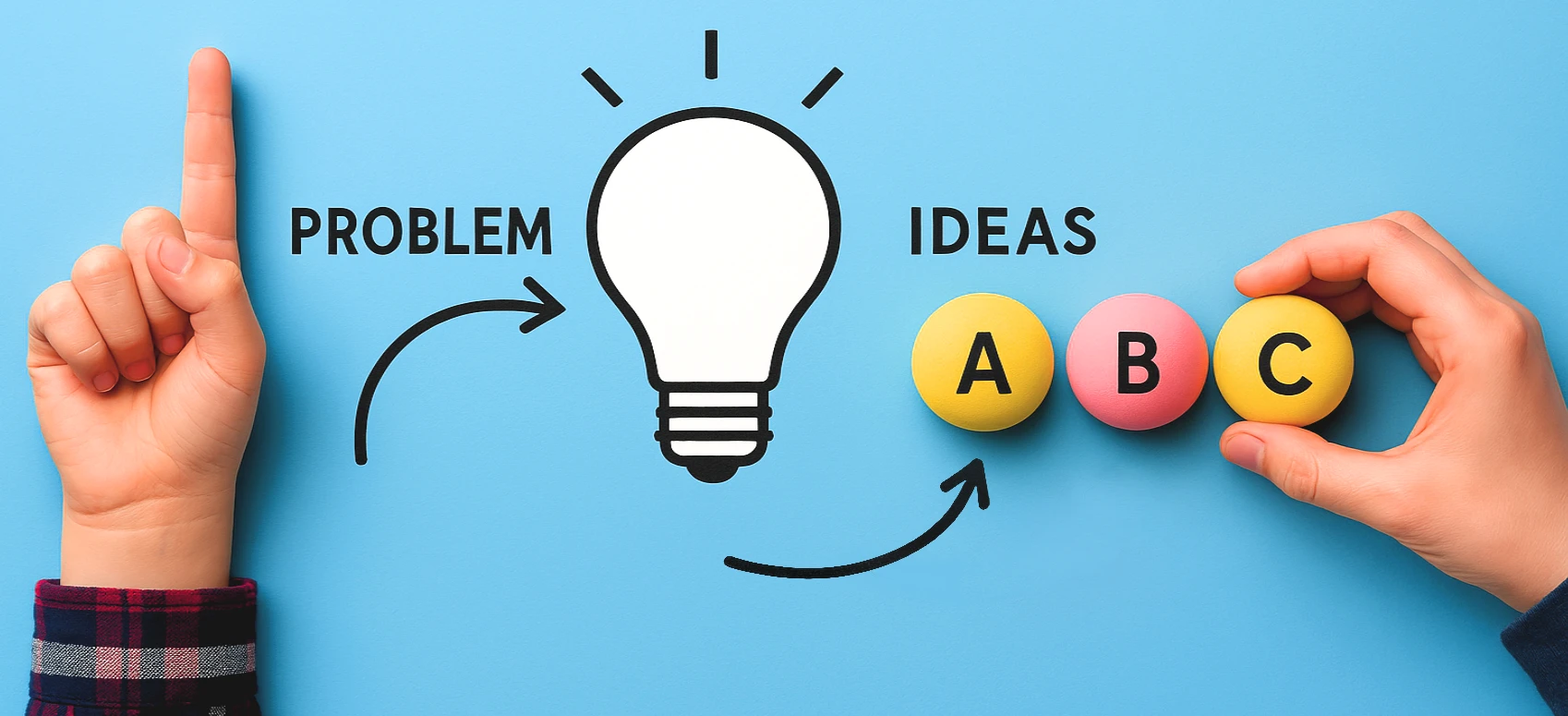
MATRIZ promotes TRIZ as a powerful tool for engineers, inventors, and consultants. But from the very beginning, TRIZ was never just a method for solving technical problems. At its core, it’s about systems thinking, the ability to spot contradictions, and the courage to go beyond the obvious – skills we all need today, not only in labs or boardrooms, but also… in classrooms.
Many of us are asking the same question: How do we prepare children for a world we don’t fully understand ourselves?
That’s why we’re excited to share the first part of an article by Iryna Melnychenko, who has been bringing TRIZ into the world of children’s and youth education with passion and determination. Iryna opens up about her own journey to explore this very question. Today we begin – and there’s more to come soon.
TRIZ in the hands of children
… teaching not what to think, but how to think
Is it possible that education – the cornerstone of every society – is no longer keeping up with the world? We live in an age of constant change. Jobs that existed for generations are disappearing. New roles are emerging – roles we hadn’t even imagined a decade ago. Technology is evolving exponentially, bringing with it a flood of data, decisions, and challenges that fall squarely on the shoulders of young people. It’s hard to keep up – especially when we’re still relying on models built for a completely different era. We continue to educate children using systems designed for the industrial age. We ask them to memorize content, pass tests, and follow the rules. But the world needs something else entirely: curious, creative, adaptable minds. People who can see the bigger picture, ask the right questions, come up with meaningful solutions – and take ownership of them.
Today’s children need new skills – not just new facts
At the beginning of my journey, I kept asking myself one question: Does the education system we know truly prepare children for the future? The more I saw, the more convinced I became that the answer is no.
“We can no longer teach young people what to think – but we can give them the tools to understand how to think.”
This isn’t just an inspiring quote – it’s the principle that guides everything I do. Because if we want to prepare children for a world full of uncertainty, knowledge alone won’t be enough. We need to give them the tools for independent thinking. In adult life, no one will care about their grades. What matters is whether they can handle real-world problems. Today’s world doesn’t reward those who can copy someone else’s ideas – it rewards those who can create something new. We live in a reality where diplomas lose their value faster than apps disappear from our phones. Employers aren’t looking for candidates with perfect transcripts – they want people who understand problems, think critically, and take action. And yet schools still try to cram as much information as possible into students’ heads – leaving young people overwhelmed and discouraged.
Data from global reports only confirms this. In December 2023, the latest PISA results were published. This international test, which has measured education levels among 15-year-olds for years, revealed something alarming: a sharp decline in reading and mathematical reasoning skills. Experts expect this trend to continue – and even worsen – as artificial intelligence plays a bigger role in our lives. The bottleneck? The human brain’s limited capacity to process information quickly. That’s why one of the most essential skills today is the ability to work with large volumes of information: to evaluate it critically, ask the right questions, spot cause-andeffect relationships, and understand systems thinking.

Since as early as 2016, the World Economic Forum has highlighted three key skills for the future: systems thinking, creativity, and independent problem-solving. In a world full of complexity and interdependence, these abilities are becoming the new human language – a language we must learn to navigate the 21st century. And yet, schools still teach using the grammar of the past. If we don’t change our approach, each new generation will be less and less equipped to handle the realities of life. And this isn’t just an education issue – it’s a problem of communities that no longer invest in thinking.

My personal journey into education
Before founding Youth Flow Academy, I was first and foremost a mother. A mother to two daughters who – like all children – asked endless questions, challenged assumptions, and saw the world through a lens completely different from mine. And although I had spent over 20 years working as a CFO in international business, it was my daughters who became my greatest source of inspiration. I started asking myself: How can we help children use their time and energy well, so they can lead effective, meaningful lives? What should a real strategy for a child’s development look like? And is today’s education system really preparing them for that?
Driven by these questions, I began exploring education systems around the world. I visited South Korea, Scotland, the UAE, Malaysia, and many European countries. I saw that education reform was happening everywhere – but often lacked coherence. Despite innovations in teaching, what was missing was a model that was practical, consistent, and growth-oriented. A model that helped children not only acquire knowledge but also shape their character.
In 2017, I attended the TRIZfest conference in Kraków. I had no idea it would become one of those pivotal moments that quietly but completely change your life. One of the presentations introduced a school in Zaporizzya called Eidos – a private institution that has been using TRIZ pedagogy with children since the late 1990s. TRIZ is a systematic, algorithmic method for solving problems originally developed for engineers – and it turned out to be surprisingly effective in education as well. That presentation connected all the dots I had been trying to make sense of for years. My business experience, my values as a mother, my reflections on education – it all suddenly came together. I saw, in action, how structure could work hand in hand with imagination. How logic could meet empathy. How analysis could lead to meaningful action.

Fascinated, I dove deeper into the subject. I studied under some of the world’s top TRIZ experts – including Mark Barkan and Sergei Ikovenko from the U.S., Sergey Yatsunenko from Poland, and Olena Hredynarova from Ukraine. But I didn’t just want to understand TRIZ. I wanted to learn how to teach it in a way that was smart, creative, and sensitive to the way children think and feel. That’s when the idea of starting my own academy was born – a place where children could grow not only in knowledge but, more importantly, in character. A place where they could question, connect, analyze, and create. Where they could think in their own way – but within a system. That’s how the vision for Youth Flow Academy came to life.
As a mother and finance professional, I knew the world my daughters were growing up in wouldn’t be simple. It would demand more than just knowledge – it would take character, courage, and adaptability. That’s why I set out to build something that would truly prepare young people for the future – not the one we remember from our school days, but the one that’s being shaped right now.
At Youth Flow Academy, I brought together three key elements: business logic, systems thinking, and TRIZ – not as a tool or technique, but as a lens for understanding the world. In TRIZ, everything begins with a question. Not “What’s the correct answer?” but “What’s really not working here?” We teach kids to spot contradictions – tensions and problems that can’t be solved using conventional thinking. And that’s where the real adventure begins. They learn to approach any topic as a system: to break it down, explore the context, and uncover the hidden relationships. Instead of falling into the routine of school – they get space for creativity, analysis, and logical thinking. Instead of hearing “because that’s how it’s done” – they’re encouraged to find their own reasons why.
Inside Youth Flow Academy
Lessons at Youth Flow Academy don’t look anything like rows of desks or neatly filled-out worksheets. It’s more like a thinking lab. Our classes are filled with movement, emotion, and purpose. Children take part in debates and creative battles where they must defend their ideas and evaluate the decisions of others. They work in teams, learn to see from different perspectives, and build logical arguments. Through startup-style projects, they launch their own initiatives – social or business – and take them from concept to execution.
TRIZ teaches kids to see the world not as a series of random events, but as a system. Every object, phenomenon, or relationship can be broken down, examined for function, mapped for connections – and then reassembled into something better. We also use ARIZ – the algorithm for inventive problem solving – a structured tool that guides children step by step through the process of creative thinking. With it, they grow more confident and start to recognize their own potential.
One of the biggest problems in education today is that young people leave school knowing how to repeat other people’s ideas – but not how to come up with their own. TRIZ changes that. Thanks to this approach, 16-year-olds are able to make thoughtful decisions. They know themselves, they understand their own development strategy, and they think in nonlinear ways. They’re ready for whatever the next 10 or 15 years may bring.
The program supports creative thinking, interdisciplinary problem-solving, analytical skills, and the ability to build strong arguments – all while encouraging kids to see life as an exciting challenge. And we – the teachers, moderators, and coaches – are there not to hand out answers, but to ask the right questions.
Youth Flow Academy is designed as a thoughtful, three-year journey of growth, tailored to children’s age, pace, and individual needs. It’s divided into three stages: for the youngest learners (ages 6–8), for primary school kids (8–10), and for teens. Each stage is built on specially designed modules that gradually introduce more complex ideas. Children work with their own activity books – created not only to grow their knowledge, but to expand their imagination. These books include illustrations, challenges, and even AR characters that draw students into the storyline and help them explore each topic on a deeper level.
In practice, it looks like this: the teacher doesn’t provide ready-made answers. Instead, they present a challenge – a problem, a conflict, a contradiction. It might be something from everyday life, something imagined, or something drawn from the world of business or society.
The children’s task is to analyze the problem as a system: to break it down into its components, examine how those elements interact, figure out what’s causing disruption – and then find ways to resolve it. They do this using universal thinking algorithms that guide them step by step. All of this happens in an atmosphere of freedom, collaboration, and deep engagement. To the kids, it doesn’t feel like “learning hard stuff” – it feels like an adventure. And most of all, it feels like their way of thinking matters.
Here, the teacher isn’t the one who “knows better.” Instead, they’re the one who asks smarter. They don’t lecture, dictate, or correct every mistake. They guide the process. Sometimes they step back to give space. Sometimes they steer the conversation in a new direction. Their role is part observer, part thought-provoker, part dialogue moderator. This teaches children to take responsibility for their own decisions. They start to see that you don’t have to be an expert to ask good questions.
And the transformation comes quickly. Children at Youth Flow Academy soon learn not just to say what they think – but why they think it. They develop analytical thinking, reasoning skills, critical and systems thinking. They learn to work in teams, make decisions, and own them. They gain self-awareness and start planning their own development paths. At some point, they stop seeing life as something that just “happens to them” – and start seeing it as an exciting challenge they have the power to shape.
To support this growth in a meaningful way, we created our own tool: the Student Development Trajectory. It helps us track what’s truly important in education – things that are often hard to measure: mindset, motivation, and maturity of thinking. This tool lets us monitor a child’s progress over time, adjust the content to their needs, and anticipate their next stage of growth. It allows us to support each student – not based on fixed standards, but on their individual potential.
By the age of 14, students at Youth Flow Academy are eligible to take the Level 1 TRIZ International Certification – a globally recognized and respected credential that proves realworld problem-solving skills. Not every child will grow up to be an engineer – but every child can become a leader.
From engineering labs to classrooms
TRIZ isn’t a theory collecting dust in a drawer. It’s a practical method – and it works. On a global scale. Today, TRIZ is used in over 50 countries and taught at more than 400 universities. It’s part of the innovation toolkit at companies like GE, Bosch, Boeing, Shell, Procter & Gamble, Samsung, and EPAM. In many of these organizations, TRIZ has become a standard in innovation, R&D, and strategic thinking. Research teams, consultants, and innovation leaders turn to it regularly.
And that proves one thing: TRIZ works wherever there’s a need for systemic, creative, and responsible thinking – including in education. Because education shouldn’t be about cramming in more facts. It should be about helping kids make sense of those facts. About giving them the tools to connect ideas and turn them into action. It should teach them to understand complexity, anticipate consequences, assess risks, and spot opportunities. That’s why TRIZ in education isn’t just a trend. It’s an investment. An investment in children who aren’t afraid of challenges. In young people who don’t wait for instructions – they create them.
There’s a quote by Steve Jobs I often come back to:
“Creativity is just connecting things. When you ask creative people how they did something, they feel a little guilty because they didn’t really do it, they just saw something. It seemed obvious to them after a while. That’s because they were able to connect experiences they’ve had and synthesize new things.”
That’s exactly what we prepare kids for at Youth Flow Academy. We give them the space and tools to connect things – knowledge with emotion, logic with intuition, facts with imagination – and from those connections, create something new. Something that’s entirely their own. I believe real education isn’t about preparing kids for tests – it’s about preparing them for life, which is complex and full of unknowns. But it’s also incredibly exciting – if we learn how to understand it and live it consciously. At Youth Flow Academy, knowledge isn’t treated as a burden or an end goal. It’s a journey. A way to discover the world – and yourself. Children here learn to ask questions, to see mistakes as part of the process, to debate, collaborate, and experiment. Our mission isn’t to produce perfect students. It’s to support the growth of authentic identity – with courage, curiosity, and a sense of responsibility for the world around them. Because this is where the future begins: in a space filled with thinking and play, logic and imagination, awareness and spontaneity.
*
This article marks just the beginning of our exploration into TRIZ-based education. In the next post, we’ll take a closer look at how TRIZ pedagogy works in practice – from specific learning formats and age-appropriate modules to the kinds of thinking skills children actually develop over time. Then, we’ll shift our focus to the world of youth entrepreneurship, showing how TRIZ helps young people transform ideas into real startup projects while building resilience, initiative, and a systems-based mindset.
Stay tuned – the journey continues.
About the author

Iryna Melnychenko
MBA, MATRIZ Certification (Level 3), ACCA Dip IFR, Vice President of MATRIZ, responsible for TRIZ Deployment in Europe. Iryna is a financial executive supporting numerous business transformation projects and the founder of the business school for kids and teenagers, Youth Flow Academy. A proven troubleshooter with a strong interest in applying TRIZ principles to business challenges.
References
- OECD (2023), PISA 2022 Results (Volume I): The State of Learning and Equity in Education, PISA, OECD Publishing, Paris, https://doi.org/10.1787/53f23881-en.
- Future of Jobs Report 2025 (2025), World Economic Forum, Geneve, Switzerland. Report available at: https://www.weforum.org/publications/the-future-of-jobs-report-2025/. Source of the picture: https://www.weforum.org/publications/the-future-of-jobs-report2025/infographics-94b6214b36/